
In April 2026, Dubai’s leadership directed every government entity to integrate all individual and business services into one unified digital platform within a year, alongside a new generation of Government Resource Planning systems spanning finance, HR, payroll, procurement, contracts, and asset management. For residents, it is a promise of something wonderful: one login, one app, every service flowing through connected systems instead of separate portals and counters. Dubai has earned the right to make that promise — the Zero Bureaucracy programme has already compressed processes that once took a dozen steps into one or two, and nearly every government service is available online today.
But behind every promise a city makes to its people, there is a team of engineers who has to keep it. And anyone who has lived through a large-scale digital programme knows the uncomfortable pattern: the work that most often decides whether a go-live date holds is not building the system. It is verifying it.
The pattern every transformation leader recognises
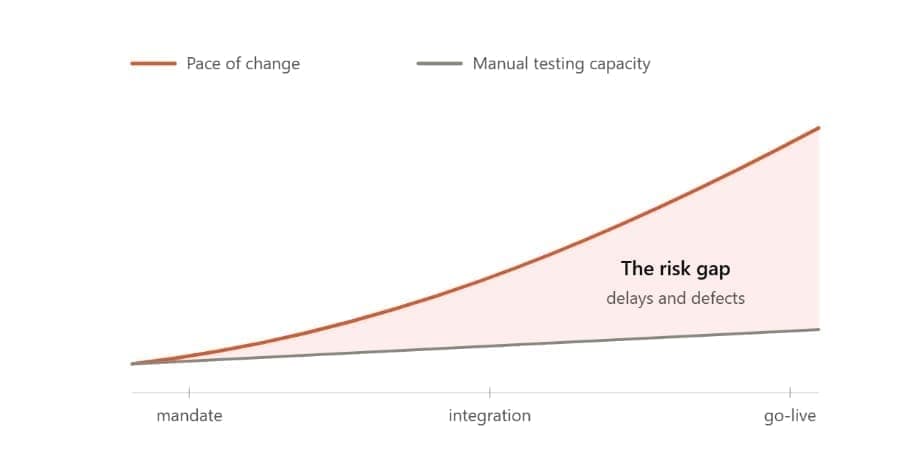
Development gets the headlines, the budgets, and the project plans. Verification gets whatever time is left, and there is never enough of it.
The pattern repeats across large transformation programmes everywhere. Systems are built on schedule; confidence in them is not. Integration work finishes, and then the real questions begin: does the payment still clear when the identity service responds slowly? Does the Arabic journey behave exactly like the English one? Does the payroll calculation survive the upgrade? Teams discover that answering those questions, thoroughly, for hundreds of business flows, before every release, takes longer than anyone planned for, because nobody planned for it. Testing was a line at the bottom of the schedule, and it quietly became the schedule.
There is a second pattern, just as familiar: the later a problem is found, the more it costs to fix. A defect caught while a flow is being built is an hour’s correction. The same defect caught in production is an incident — with investigation, emergency fixes, re-testing, communication, and, in government, a citizen on the other end of it. Every experienced technology leader has felt this asymmetry firsthand. It is the strongest practical argument for treating verification as a first-class workstream rather than a final checkpoint.
The people the deadline actually lands on
Talk to anyone working inside a government entity’s IT or quality team right now, and you will hear a version of the same story.
There is the QA lead who knows that “integrate with the unified platform” means her regression suite, built painstakingly over three years for her entity’s own portal, may not survive the migration. There is the ERP administrator watching the new resource planning systems roll in and quietly wondering how anyone will verify that an employee’s salary calculation still works after every upgrade cycle. There is the service delivery manager who dreads Sunday mornings after a weekend release, refreshing the helpdesk queue to see what broke.
None of these people oppose the vision. Most of them are residents too, and they use these services themselves. Their struggle is practical: transformation mandates arrive with deadlines, but testing capacity does not scale on command. And when systems change this fast, the testing burden compounds. Every integration with a shared identity system, payment gateway, or data platform is a new failure point owned partly by someone else. New citizen-facing experiences still sit on top of legacy systems that must be tested together, end to end, even as the engineers who understand those older systems grow scarce. Arabic and English flows are separate user journeys, each demanding verification, doubling the surface area of every release. And the release cadence itself keeps rising — digital government is no longer a project with a finish line but a continuous programme of upgrades, patches, and policy-driven changes, each demanding a regression cycle.
Even entities that invested early in traditional test automation feel a version of this pain: scripted tests break whenever screens, fields, or workflows change, and in a unification programme, everything changes. Much of the team’s capacity ends up spent keeping yesterday’s tests alive, precisely when the programme needs that capacity for new work.
Why this matters more in government than anywhere else
In a private company, a failed release costs revenue. In government, it costs trust.
When a payment fails on a licensing portal, a business owner does not experience “a defect in the integration layer.” She experiences a government service that did not work when she needed it. When a payroll system miscalculates after an upgrade, a public employee does not see a regression gap. He sees his salary, wrong, at the end of the month.
Dubai’s digital reputation has been earned through years of services that simply work. Protecting that reputation through a period of unprecedented system change is, at its core, a quality engineering challenge. Entities that treat testing as an afterthought will discover the bottleneck at the worst possible moment — the week before go-live. Entities that treat it as a first-class capability stand a far better chance of hitting the deadline with confidence.
Where AI genuinely changes the testing equation
“AI” appears in almost every technology conversation in the UAE today, so it is worth being precise about what it actually changes in testing, because the difference is structural, not cosmetic.
Self-healing tests attack the maintenance burden. Traditional scripts break whenever an element moves, a field is renamed, or a workflow shifts. AI-driven automation can recognise those changes and adapt tests automatically, converting what used to be weeks of script repair into a non-event, and freeing the team’s capacity for the new work a transformation actually demands.
Recording replaces coding. AI-assisted test creation lets a tester, or a business user who simply knows the process, perform a workflow once and have it captured as a reusable, executable test. Test creation stops being gated behind scarce automation engineers, which matters enormously in a market where skilled QA automation talent is among the hardest roles to hire.
Change impact analysis focuses effort where risk lives. Rather than re-running everything after every change, AI can identify which business flows a release actually affects, so a one-night regression window is spent on the flows that matter instead of spread thin across all of them.
Scale without proportional headcount. Because AI absorbs the repetitive work of creation and maintenance, testing capacity can finally grow at the pace of a transformation programme rather than at the pace of recruitment.
For government entities, the strategic implication is straightforward: AI in testing is not about replacing QA teams. It is about ensuring the mandate’s verification workload does not fall on manual effort that was never designed to absorb it.
Rethinking testing for the pace of transformation
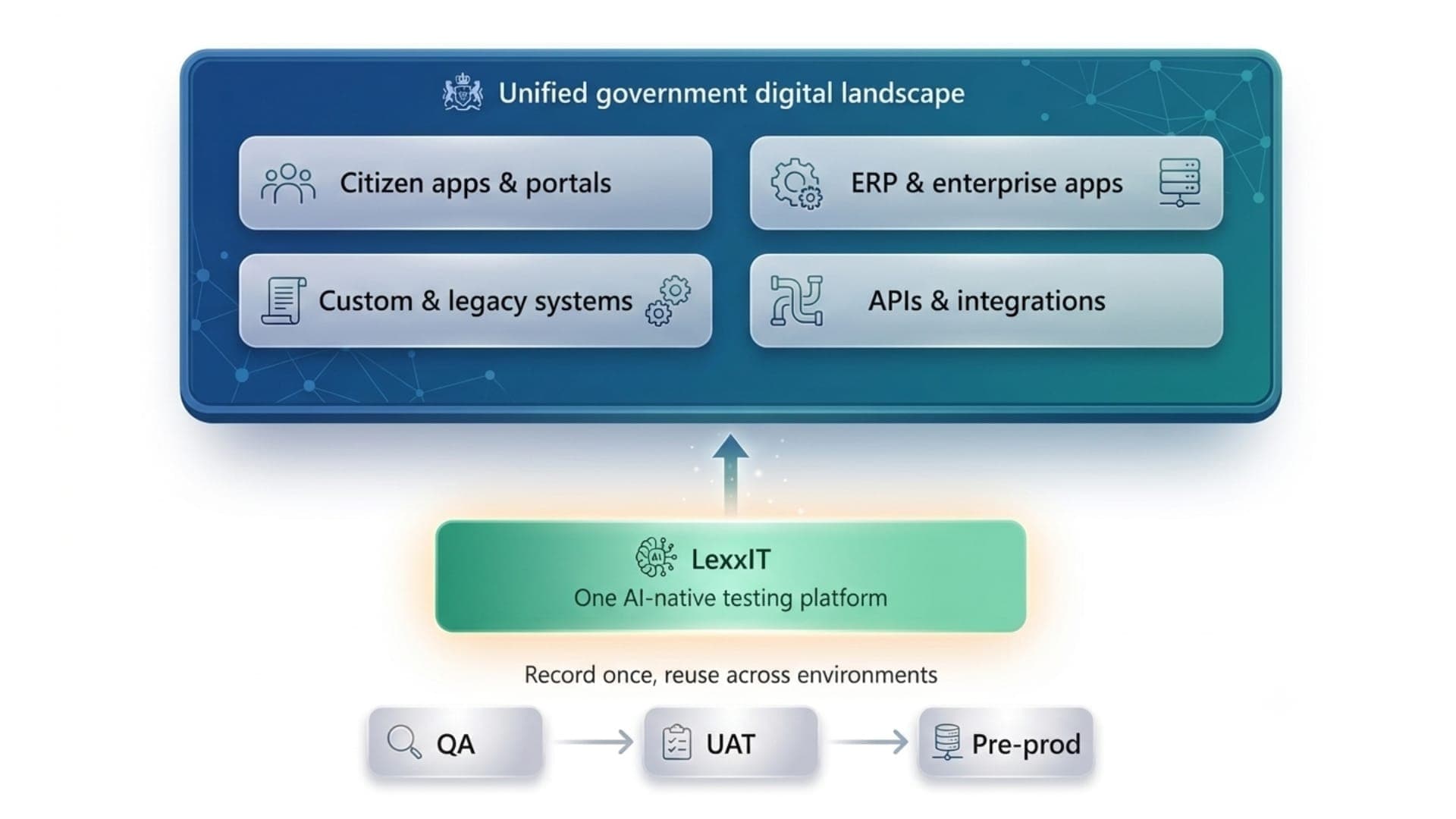
This shift is already underway. Modern AI-native automation platforms such as LexxIT are changing how large organisations approach exactly this class of problem: a single platform that can validate digital citizen experiences, services and data layers, custom and legacy systems, and enterprise applications such as Oracle, SAP, Salesforce, and ServiceNow, end to end, rather than in fragments each tool happens to see.
In practice, that changes the day-to-day reality of a mandate like Dubai’s in a few concrete ways. Business flows recorded once can be reused across QA, UAT, and pre-production environments, so the test asset outlives the migration it validates. A no-code approach means the licensing officer or HR operations analyst who actually knows the process can contribute to automating its verification. Multi-language support means Arabic and English journeys are covered within the same effort rather than as a second project that never quite gets resourced. And when a full regression cycle takes hours instead of weeks, frequent releases stop being a source of dread — teams move from hoping nothing broke to knowing.
“The deadline is fixed. The bottleneck is no longer inevitable.”
— Eti Gautam
Dubai’s one-year unification mandate reflects the emirate’s long track record of delivering ambitious digital transformation initiatives. The real question is what the journey feels like for the teams delivering it: a year of midnight regression marathons and anxious go-lives, or a year in which quality assurance moves at the pace of the transformation it protects.
Testing becomes a bottleneck when a model built on manual effort and brittle scripts is asked to absorb continuous change. That model is what is obsolete, not the ambition. With an AI-native approach to test automation, the bottleneck can be significantly reduced, and verification can become what it should always have been: the thing that lets a government move fast because it is confident, not despite being unsure.
To see what this looks like in practice, read how a large enterprise used LexxIT’s AI Test Script Recorder to automate hundreds of complex business flows across multi-language, ERP-integrated systems and significantly compress its UAT timelines: Accelerating UAT Automation with LexxIT
Or talk to our team about your entity’s testing roadmap for the year ahead: sales@letitbexai.com | www.lexxit.ai
LexxIT is an AI-native unified test automation platform by Letitbex AI Technologies LLC, Dubai, UAE.