
Something quietly important has happened inside life sciences over the past eighteen months. Artificial intelligence has moved from a promising set of pilots into a working part of how the industry discovers molecules, runs trials, monitors safety signals, and manages regulatory intelligence. With that move, a new vocabulary has entered the room.
- Boards ask how AI decisions are documented.
- Auditors ask which model version was in production on the day a signal was raised.
- Procurement teams, buying on behalf of top-twenty pharmaceutical companies, now reference ISO/IEC 42001 in their RFPs alongside ISO/IEC 27001 and GxP compliance.
- Sponsors ask CROs to show the AI Management System that governs their clinical operations platform.
- Regulators, from the FDA to the EMA to India’s CDSCO, are converging on similar expectations for lifecycle traceability of AI-influenced decisions.
This is the vocabulary of trust, one of the most encouraging developments in the industry’s relationship with AI. The conversation has grown up.
Life sciences has done this before
The reason to be optimistic is straightforward: life sciences already knows how to convert regulation into operating discipline. GxP, GAMP, 21 CFR Part 11, GDPR, HIPAA, each began as an external requirement and became internal muscle. Quality Management Systems, pharmacovigilance systems, validated computerised systems, audit trails, change control. The industry has built more governance operating models than almost any other, and continued to accelerate innovation while doing so.
AI governance is a familiar kind of new. It asks the industry to do what it has always done well, translate an external framework into a working management system, for a class of technology that is more probabilistic, more data-hungry, and more consequential than the systems it joins.
What “good” looks like in 2026
The AI Management System, Layered on Existing Foundations
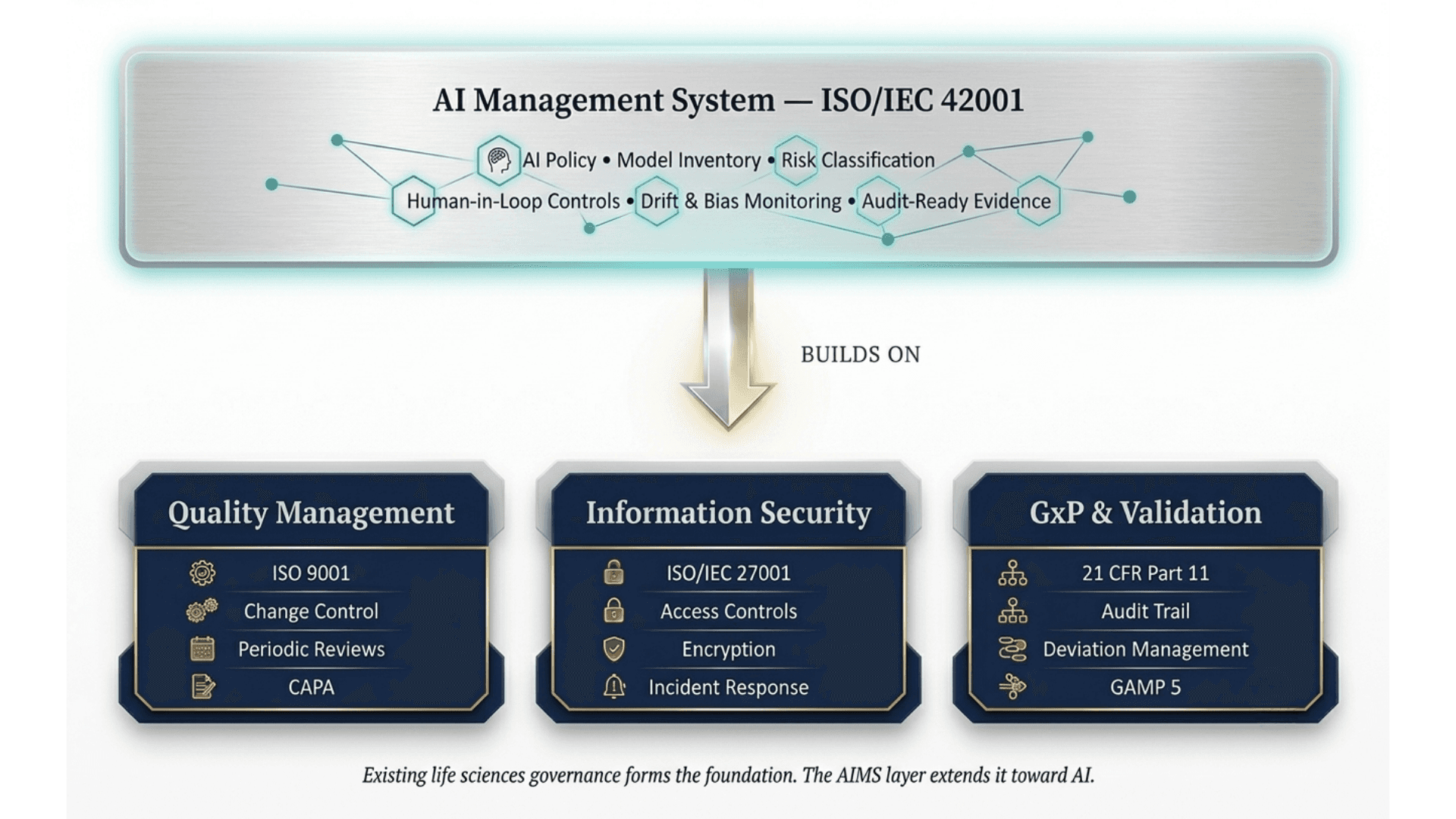
An AI Management System (AIMS) built on ISO/IEC 42001 is emerging as the standard reference across regulated industries. For life sciences leaders, the parallels come naturally: an AI Policy alongside the Quality Policy, lifecycle discipline that mirrors product development, risk assessment in the language of ICH Q9, and monitoring that treats model behaviour the way pharmacovigilance treats post-launch signal.
Three ideas are becoming central.
Accountability by design. For every AI system in production: a named human owner, a clear escalation path, and a decision-rights map that mirrors medical, quality, and regulatory hierarchies. In 2026, who owns this decision is a question every AI system is expected to answer.
Explainability as a lifecycle discipline. From feature engineering to model retirement, evidence is captured continuously and stored where auditors can find it. This is where the industry gains an advantage, because continuous evidence capture is already how life sciences runs validated systems.
Governance as an operating rhythm. Quarterly model reviews, drift assessments, bias monitoring, and revalidation cycles look like the periodic quality reviews the industry already runs. The AIMS becomes another meeting on the executive calendar, visible, measured, and steadily improving.
Together, these turn AI governance from a documentation exercise into a management discipline, one operating fabric, one language, one source of evidence for the CDO, Head of Quality, and Head of Regulatory alike.
The Letitbex AI perspective
Our own investment in ISO/IEC 42001, alongside ISO 9001, ISO/IEC 27001, and CMMI Maturity Level 3, reflects a straightforward conviction: governance and delivery move at the same speed, and when they do, both compound.
That conviction shows up in the outcomes we work toward with life sciences clients:
- Faster time-to-value on AI use cases, because the governance artefacts required at audit are produced during delivery rather than reconstructed after it.
- Higher board and regulator confidence, because model ownership, decision rights, and evidence trails are visible from day one.
- Cleaner RFP responses, because the AIMS discipline is already operating, and sponsors, CROs, and procurement teams can see it working.
- Lower total governance cost, because the AIMS layer sits comfortably on top of existing QMS, ISMS, and GxP practices rather than duplicating them.
The organisations we work with tend to describe the shift the same way: AI stops being a portfolio of promising initiatives and becomes a governed capability the enterprise can scale with confidence.
Where this is going
The most consequential shift in enterprise AI is happening in life sciences before anywhere else, and the driver is a very old idea returning to the surface, that the industries the world trusts to be careful are the industries that write the operating standards everyone else eventually adopts.
“Life sciences wrote the playbook for good manufacturing. It wrote the playbook for good clinical practice. It is now positioned to write the playbook for governed enterprise AI.”
— Eti Gautam
That authorship is worth claiming.